
Stopping the Bleeding Through a Pinhole: Dr. John Pavlus on Trauma Interventional Radiology Techniques

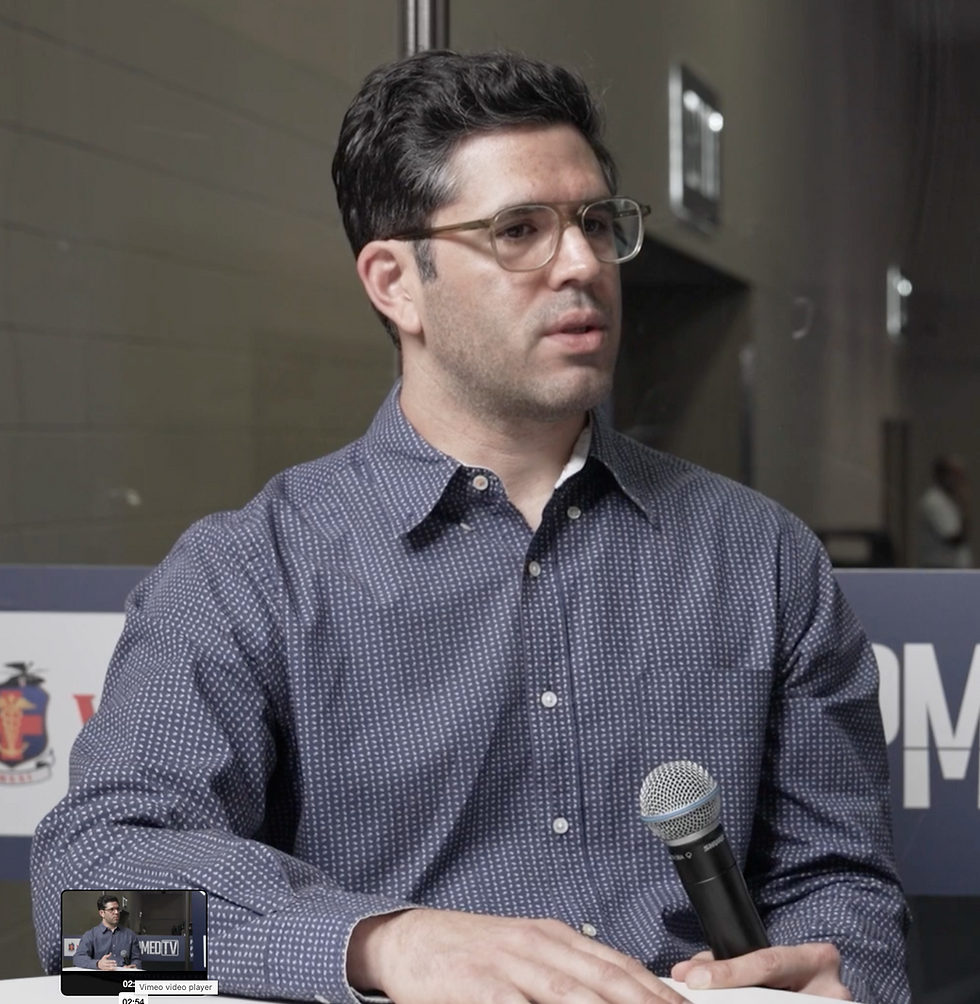
When a trauma patient is bleeding from a vessel no surgeon's hand can reach, someone calls interventional radiology. In this companion conversation to their earlier episode, host and vascular surgeon Dr. Wayne Causey asks Dr. John Pavlus, Chief of Interventional Radiology at Brooke Army Medical Center, to skip the overview and walk through exactly what happens next.
The Scan Comes First
Before anything is touched, there is a picture. Contrast is injected and the scanner takes images at three separate moments: before the injection, the arterial phase, and again after a brief delay. Comparing those three moments is how a physician tells active arterial bleeding from a contained pocket of blood, or from an old finding that was never bleeding at all. It matters more than it sounds. A scan performed at an outside hospital for a different purpose can make a patient look like an arterial bleeder when the bleeding is coming from a vein, and a vein is not something a catheter can easily fix.
Sixty Minutes, and No Time to Argue
At Brooke Army Medical Center a trauma surgeon watches the scan on the technologist's screen. If he calls a bleed, a single alert reaches the interventional radiologist, the nurse, the technologist, and the resident at the same moment, and all of them drive in. The standard is a needle in the artery within sixty minutes of that call. Reaching it consistently required stripping every point of debate out of the process, which only became possible after years of two services learning to trust each other. Anesthesia is activated at the same time, because these patients are almost never stable enough to manage without it.
The Liver Is Harder Than It Looks
The vasculature of the liver is complex. Bleeding from certain locations cannot be reached quickly using endovascular techniques, which is why certain grades of liver injury belong in an operating room with a surgeon rather than in a radiology suite. Recognizing which situation you are in, before committing to a course, is the real skill.
Twenty Minutes to Stop a Spleen
For Splenic bleeding, a coil is placed at a precise landmark between two small pancreatic arteries, and the bleeding slows to something the body and the trauma team can manage. The technique is refined to the point of a flow state, with every person in the room knowing what comes next. But there is also honesty about the limits: in an unstable patient at two in the morning, the goal is not a textbook result. The goal is a live patient who can be handed back.
The Tool You Would Take to War
The most striking part of the conversation is the simplest. Thrombin is a clotting agent injected through the skin with a needle, guided by ultrasound. It needs no X-ray suite, no power injector, and no shelf of catheters. It is the standard repair for a contained pocket of blood in the groin, and it has been extended to bleeding inside solid organs and small vessels that would be nearly impossible to reach with a catheter. Asked what he would carry into a far forward combat setting, that is the answer.
The through line is not equipment. It is repetition, the same approach performed the same way until it costs no thought at all, freeing the mind for the decisions that actually matter. Listen to the full conversation and share it with a colleague who has ever wondered how internal bleeding gets stopped without an incision.
HOW TO WATCH
Check out the full episode featuring Dr. John Pavlus on Interventional radiology techniques on our YouTube channel: https://youtu.be/33bOO24OE8I
Honoring the Legacy and Preserving the History of Military Medicine
The WarDocs Mission- WarDocs exists to honor the legacy of Military Medicine, preserve its history, and inspire every generation — across all Services, Corps, and Ranks — to serve with excellence and pride. Through mentorship, coaching, and education, we equip those considering, entering, and serving in military medicine with the knowledge, connections, and community they need to thrive. We celebrate Who we are, What we do, and, most importantly, How we serve Our Patients, the DoW, and Our Nation.
Find out more and join Team WarDocs at https://www.wardocspodcast.com/
Check our list of previous guest episodes at https://www.wardocspodcast.com/our-guests
Subscribe and Like our Videos on our YouTube Channel: https://www.youtube.com/@wardocspodcast
Listen to the “What We Are For” Episode 47. https://bit.ly/3r87Afm
WarDocs- The Military Medicine Podcast is a Non-Profit, Tax-exempt-501(c)(3) Veteran Run Organization run by volunteers. All donations are tax-deductible and go to honoring and preserving the history, experiences, successes, and lessons learned in Military Medicine. A tax receipt will be sent to you.
WARDOCS documents the experiences, contributions, and innovations of all military medicine Services, ranks, and Corps who are affectionately called “Docs” as a sign of respect, trust, and confidence on and off the battlefield, demonstrating dedication to the medical care of fellow comrades in arms.
Follow Us on Social Media
Twitter: @wardocspodcast
Facebook: WarDocs Podcast
Instagram: @wardocspodcast
LinkedIn: WarDocs-The Military Medicine Podcast
YouTube Channel: https://www.youtube.com/@wardocspodcast


The term 10.10 0.1 highlights why accurate formatting matters when working with network addresses. Before opening a router administration page, users should confirm the correct local IP address from their device documentation instead of assuming a search phrase is valid.
Halloween-inspired worlds bring spooky decorations, ghosts, pumpkins, and darker backgrounds into the jumping adventure Doodle Jump while keeping the gameplay light and playful.