
Triage When You Can't Evacuate- RDML Anthony LaCourse

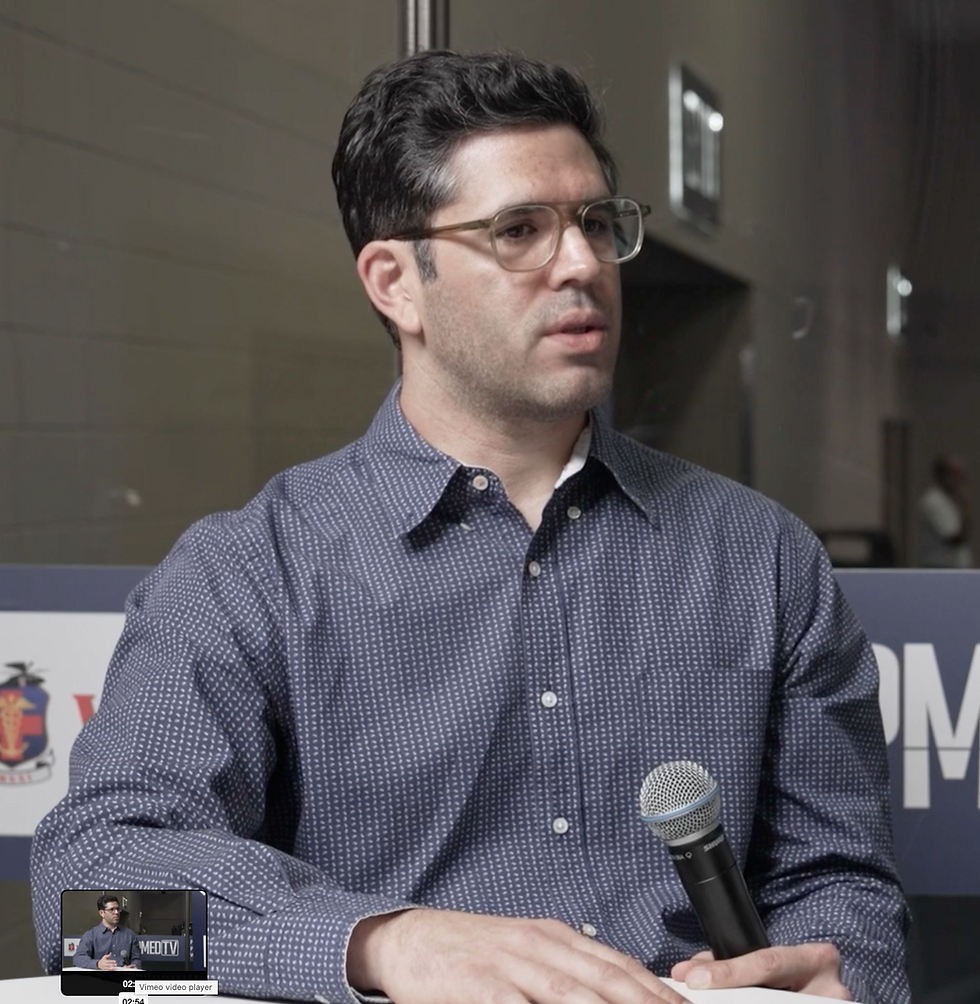
What does a young corpsman do on day one when a patient will die on day four without evacuation, and no evacuation is coming? RDML Anthony LaCourse, Director of the Medical Service Corps for the Navy Reserve, has thought hard about that question. He sat down with WarDocs and OpMed TV at the Defense Strategies Institute Operational Medicine Symposium to explain how the Navy and Marine Corps should prepare for it.
A different fight, a different triage
RDML LaCourse describes the next fight as multi-domain, multimodal, and littoral, shaped by distributed maritime operations and expeditionary advanced base operations. In that environment the medical force cannot count on air superiority or fast evacuation. He says triage for that future will be vastly different from the golden hour model the force grew up with, and he notes that these views are his own, not DoW policy.
The moral injury nobody trains for
RDML LaCourse names the cost directly. Young corpsmen and medics will face patients they cannot move, and some will die. He asks whether a young provider can classify a patient with a belly gunshot wound as expectant on day one, because the logistics to keep that patient alive for evacuation will not exist. Dr. Doug Soderdahl recalls serving as the triage officer at a combat support hospital in Iraq and wishing he had been able to practice those decisions before he made them.
His answer is AI-driven simulation. Give providers a defined environment, a fixed number of seats on the next aircraft, and thirty patients whose vital signs keep changing, then ask who they would move. The point, he says, is to build judgment, not to score survival rates.
Corpsmen as PAs in waiting
RDML LaCourse began as a hospital corpsman, and he treats corpsmen as colleagues with room to grow. He wants more of them trained as paramedics. If every fifth or tenth corpsman held that skill, he argues, one provider could manage five or six patients while the others handle the minute-to-minute work. He describes how he mentors corpsmen with short tasks, then wider latitude, and recalls corpsmen in Okinawa functioning at the independent duty level when no medical officer was nearby.
Unmanned platforms and the limits of providers
Asked which technology excites him, RDML LaCourse points to unmanned patient movement. He describes an unmanned ground vehicle programmed along ambulance exchange points so a team could fire and forget from a role two. With limited resources, he says, the force cannot put a nurse, PA, or paramedic on every movement, and it will have to send some patients ahead on their own.
Total force, civilian reps, and advice for young officers
On readiness, RDML LaCourse favors embedding reserve units inside active duty exercises and pairing reserve corpsmen with busy civilian emergency departments for regular reps. For officers starting out, his advice is plain: find mentors at every level, from a master chief to a flag officer, and keep the shot angle higher than you need.
Watch or listen to the full conversation and share it with the corpsmen, medics, and officers who will have to make these decisions. The questions RDML LaCourse raises belong in every operational medicine planning meeting.
HOW TO WATCH
Check out the full episode featuring RDML Anthony LaCourse on our YouTube channel:
GUEST BIO
RDML Anthony LaCourse is Director of the Navy Reserve Medical Service Corps and the first physician assistant to reach flag rank. A native of Ipswich, Massachusetts, he began his naval career in 1987, trained as a hospital corpsman in 1988, and was commissioned into the Medical Service Corps in 1993. He served as Marine Corps Central Command Force Surgeon from October 2023 to September 2025 and commanded the 4th Medical Battalion from 2020 to 2023. His operational assignments include Afghanistan, Okinawa, and Korea. In 31 years as a physician assistant, he has practiced in thoracic surgery, endocrinology, and emergency medicine.
More from the Operational Medicine Symposium
This episode is part of the WarDocs and OpMed TV interview series recorded at the Defense Strategies Institute Operational Medicine Symposium in San Antonio, March 2026. Watch the full set of DSI OP MED videos here: https://hubs.li/Q04jRhjP0
Honoring the Legacy and Preserving the History of Military Medicine
The WarDocs Mission- WarDocs exists to honor the legacy of Military Medicine, preserve its history, and inspire every generation — across all Services, Corps, and Ranks — to serve with excellence and pride. Through mentorship, coaching, and education, we equip those considering, entering, and serving in military medicine with the knowledge, connections, and community they need to thrive. We celebrate Who we are, What we do, and, most importantly, How we serve Our Patients, the DoW, and Our Nation.
Find out more and join Team WarDocs at https://www.wardocspodcast.com/
Check our list of previous guest episodes at https://www.wardocspodcast.com/our-guests
Subscribe and Like our Videos on our YouTube Channel: https://www.youtube.com/@wardocspodcast
Listen to the "What We Are For" Episode 47. https://bit.ly/3r87Afm
WarDocs- The Military Medicine Podcast is a Non-Profit, Tax-exempt-501(c)(3) Veteran Run Organization run by volunteers. All donations are tax-deductible and go to honoring and preserving the history, experiences, successes, and lessons learned in Military Medicine. A tax receipt will be sent to you.
WARDOCS documents the experiences, contributions, and innovations of all military medicine Services, ranks, and Corps who are affectionately called "Docs" as a sign of respect, trust, and confidence on and off the battlefield, demonstrating dedication to the medical care of fellow comrades in arms.
Follow Us on Social Media
Twitter: @wardocspodcast
Facebook: WarDocs Podcast
Instagram: @wardocspodcast
LinkedIn: WarDocs-The Military Medicine Podcast
YouTube Channel: https://www.youtube.com/@wardocspodcast
Photos and other visual information (VI) in this post are provided by the guest or obtained from DVIDS (dvidshub.net). Department of War VI created by U.S. Government employees in their official duties is generally not eligible for U.S. copyright protection. WarDocs uses this material without implying endorsement by the Department of War or any federal entity, and no endorsement of any individual, business, organization, product, service, political party, or candidate is stated or implied.
Original photos used in the post can be found at the following links:


Comments