
Hours, Not Minutes: COL Shaun Brown, MD on the Research That Will Keep the Next Generation of Wounded Alive

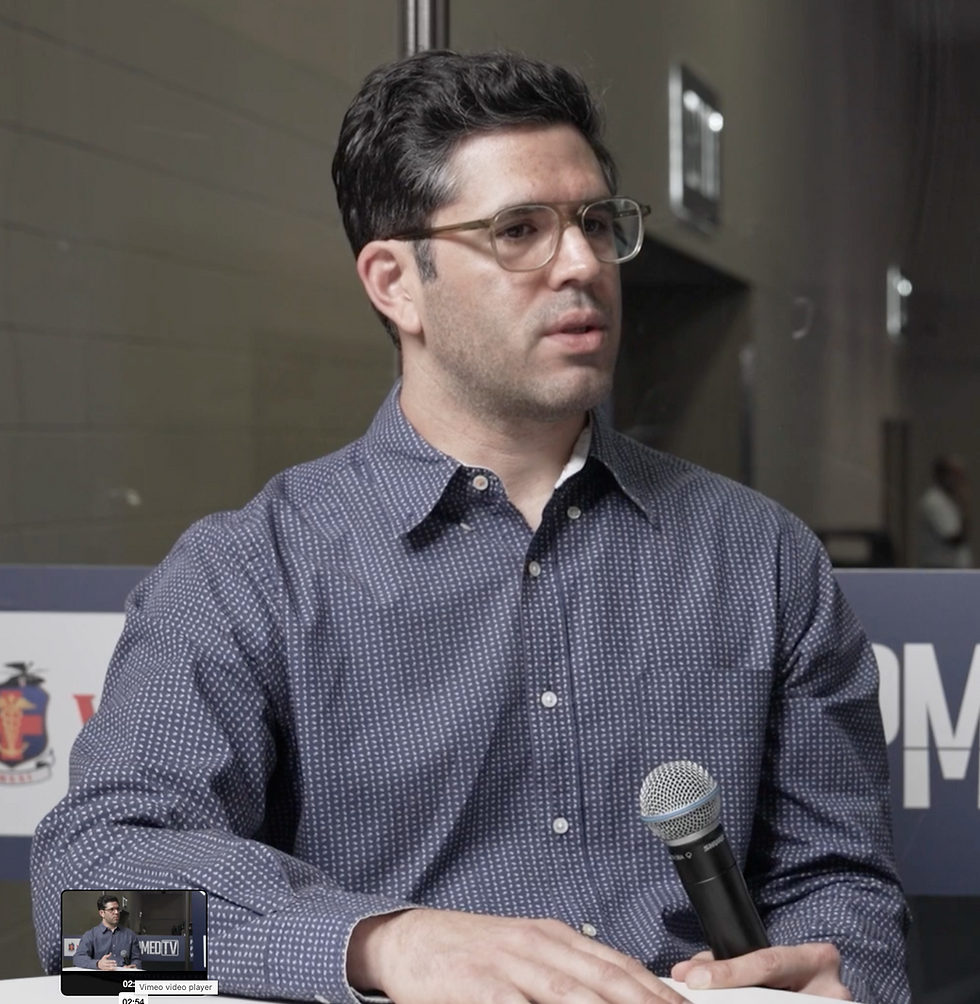
The golden hour was a promise military medicine could keep in Iraq and Afghanistan. In a future large-scale conflict, it may not be a promise anyone can make. COL Shaun Brown, MD, Commander of the U.S. Army Institute of Surgical Research, sat down with WarDocs and OpMed TV at the Defense Strategies Institute OP MED Symposium to explain what that means for the research enterprise he leads.
A Rejection, Then September 11th
COL Brown planned to attend the U.S. Naval Academy. Bad eyesight closed that door, so he went to a civilian undergraduate program and started pre-med coursework. When 9/11 happened, the decision made itself — he would go into medicine, and he would do it in uniform. He took an Army Health Professions Scholarship, choosing the Army's four-year award over the Air Force's three-year offer.
From Colorectal Surgery to Fort Bragg
As a general surgery resident at William Beaumont Army Medical Center, Dr. Brown looked for a fellowship that would add technical range he could use in civilian practice and on the battlefield. Colorectal surgery fit. The Beaumont program also carried a long, quiet relationship with the special operations community: a resident would schedule a case with an attending, show up, and find someone else covering because the attending had left town overnight for operational requirements. He got the recruiting call while loading a moving van in New Orleans, spent a year on staff in El Paso, completed assessment and selection, and moved to Fort Bragg the following summer.
Autonomous Evacuation Is Only Half the Answer
Asked what excites him most at the ISR, COL Brown points to the Organ Support and Automated Technology department. He uses a widely shared video of Ukrainian forces evacuating an amputee by unmanned ground system to make the point. The evacuation worked, but it took several attempts and several hours. It reminded him of Afghanistan in 2013, when his team would perform damage control surgery on Afghan partners, intubate them, arrange transport — and watch the receiving hospital move the patient from the helipad without a ventilator or even a bag. A platform that cannot sustain a patient en route can only move the walking wounded. What is needed alongside it is autonomous medical support: ventilators that register changing physiology and adjust themselves, autonomous IV pumps, and whatever else that Soldier requires to survive the trip.
The Wound That Cannot Be Evacuated
COL Brown's concern is combat wound research, where he sees funding eroding against competing requirements. His reasoning is blunt. In large-scale combat operations, there is a good chance most damage control surgery will be done for sepsis, not hemorrhage. Casualties in uncontrolled hemorrhage far from a surgical team frequently do not survive the evacuation delay — a pattern visible in Ukraine. The patients who become emergencies are the ones whose survivable wounds could not be evacuated and who arrive with septic extremities. Combat wound solutions, he argues, will be central to the next fight.
Blood That Does Not Need a Refrigerator
Resuscitation has moved from component therapy to one-to-one-to-one ratios to whole blood, ideally warm whole blood. Dr. Brown's assessment is that low-titer O will not be available in the quantities a large-scale conflict demands, which means components come back into play — and with them, cold chain storage and logistical burden. The answer is shelf-stable. One freeze-dried plasma product holds an Emergency Use Authorization and others are approaching FDA approval. The ISR has done substantial work on spray-dried plasma, which is quicker and cheaper to produce and requires equipment roughly the size of two ATMs rather than a large manufacturing facility — a decisive advantage for distributed production. Work continues on freeze-dried and spray-dried platelets and on freeze-dried red cells.
Burns, Readiness, and the Force That Has to Deliver
The Army Burn Center at Brooke Army Medical Center is the ISR's most visible capability, and a future fight involving thermal weapons, lasers, and fuel could generate burn volumes the system has not faced in generations. COL Brown breaks the problem into supply, training, and partnership: enough crystalloid and plasma forward, teams that can calculate burn surface area correctly, the Advanced Burn Life Support course scaled for deploying units, and formal relationships with civilian burn centers — including placing Army burn surgeons in MIL-CIV partnerships. On surgical readiness more broadly, he describes a diversified platform: military treatment facility caseload supplemented by community hospital and underused VA partnerships. What surgeons need is not trauma volume but complexity.
COL Brown closes with a maxim from the Army War College: you train for the known and you educate for the unknown. In an interwar period when experienced people are leaving, his question is simple — if he left, who would be here to educate the residents coming up for a fight nobody has seen yet. Listen to the full conversation and join Team WarDocs at wardocspodcast.com.
COL BROWN BIO
Colonel Shaun R. Brown, Commander of USAISR, is a distinguished military surgeon originally from St. Louis, Missouri. After completing his medical education at A.T. Still University and his General Surgery Residency at William Beaumont Army Medical Center, he went on to complete a Colon and Rectal Surgery Fellowship at the Ochsner Clinic in 2015.
A dedicated combat surgeon, COL Brown has deployed multiple times to Afghanistan and Iraq, serving with the 28th CSH, the 160th FST, and in support of USSOCOM. During his tenure at Womack Army Medical Center, he served as Chief of Surgery and notably established the Army’s first new General Surgery Residency program in over forty years. Recently, he completed Senior Service College as a Veterans Affairs Fellow.
HOW TO WATCH
Check out the full episode featuring COL Shaun Brown, MD, on our YouTube channel: https://youtu.be/gzrAqxXM8CA
Honoring the Legacy and Preserving the History of Military Medicine
The WarDocs Mission
WarDocs exists to honor the legacy of Military Medicine, preserve its history, and inspire every generation — across all Services, Corps, and Ranks — to serve with excellence and pride. Through mentorship, coaching, and education, we equip those considering, entering, and serving in military medicine with the knowledge, connections, and community they need to thrive. We celebrate Who we are, What we do, and, most importantly, How we serve Our Patients, the DoD, and Our Nation.
Find out more and join Team WarDocs at https://www.wardocspodcast.com/
Check our list of previous guest episodes at https://www.wardocspodcast.com/our-guests
Listen to the “What We Are For” Episode 47. https://bit.ly/3r87Afm
WarDocs- The Military Medicine Podcast is a Non-Profit, Tax-exempt-501(c)(3) veteran-run organization supported by volunteers. All donations are tax-deductible and go to honoring and preserving the history, experiences, successes, and lessons learned in Military Medicine. A tax receipt will be sent to you.
Make a Tax-Deductible Donation to Support WarDocs
WARDOCS documents the experiences, contributions, and innovations of all military medicine Services, ranks, and Corps who are affectionately called "Docs" as a sign of respect, trust, and confidence on and off the battlefield, demonstrating dedication to the medical care of fellow comrades in arms.
Follow Us on Social Media
Twitter: @wardocspodcast
Facebook: WarDocs Podcast
Instagram: @wardocspodcast
LinkedIn: WarDocs-The Military Medicine Podcast
WarDocs on YouTube
We Are WarDocs: https://youtu.be/IOC3sCNF9RI?si=NGNwguReefbVMgPW


snowrider
Great collect wrapped presents
This post on the importance of timely research in trauma care is enlightening, especially how it can reshape future medical practices. I wonder, how do you see technology like Drift Boss influencing quick decision-making in critical situations?