
From the White House Medical Unit to Rebuilding Trust Across the VA- CAPT (Ret) Gerard R. Cox, MD

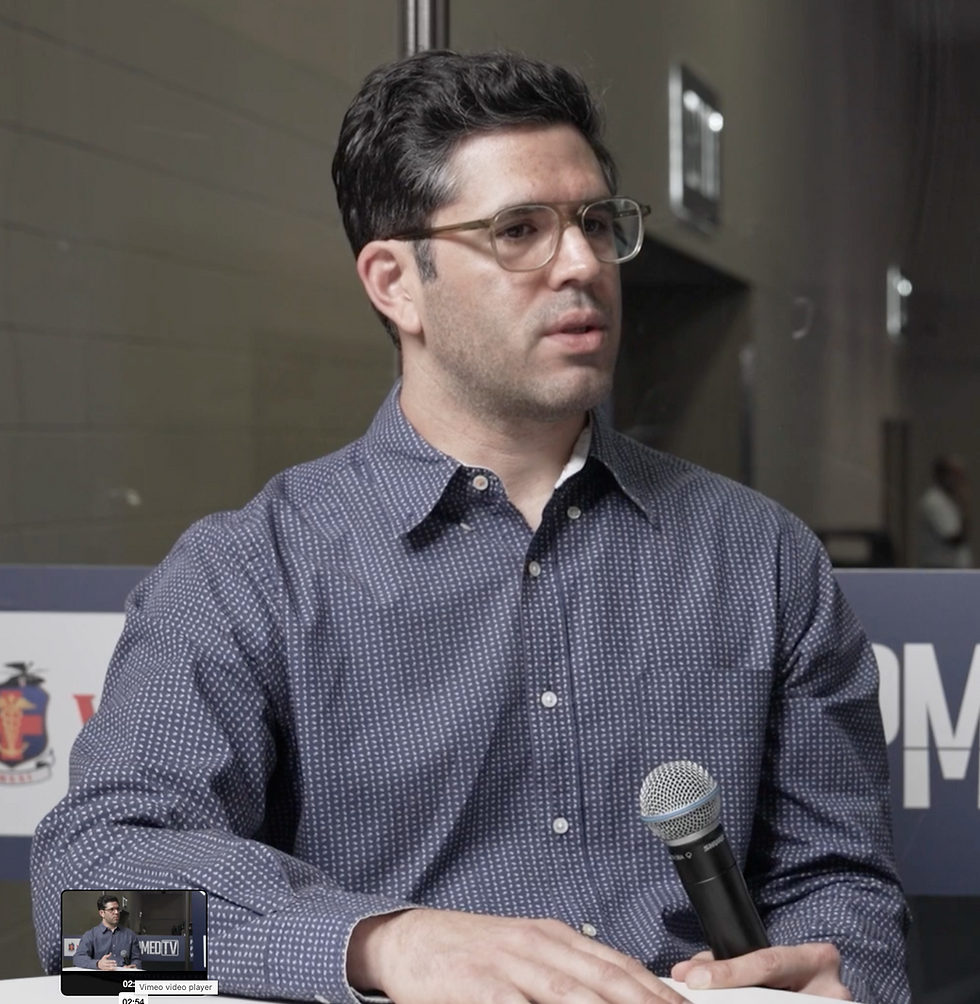
Retired Navy Captain Gerard CAPT(Ret) Cox, MD, held the black bag a few seconds from two presidents, ran medical support for the U.S. Fifth Fleet, and walked into the VA Office of the Medical Inspector three months after the worst scandal in that agency's modern history. Thirty years in uniform and nearly eleven more in senior VA leadership gave him an unusual vantage point, and his career argues that the hardest problems in military medicine are cultural, not clinical.
An accidental career. CAPT(Ret) Cox joined the Navy through the Health Professions Scholarship Program because his parents had already stretched to pay for college, planning four years and an exit to a New England practice. An internship at Bethesda convinced him within months that general medicine was not his path, and a flight surgeon tour with Marine squadrons out of Cherry Point gave him the space to figure out what was. He came back to emergency medicine, then a young specialty fighting established departments for offices and administrative time. He finished at thirty years.
Seconds, not medicine. From 1999 to 2001 CAPT(Ret) Cox served in the White House Medical Unit under Presidents Bill Clinton and George W. Bush. Both were young and healthy, which made the job a test of positioning rather than clinical acuity. A White House physician is always within seconds of the president, monitoring the same Secret Service frequency the detail uses to track his movements, with a nurse and an ambulance staged in the motorcade behind him. That doctrine traces to 1981, when John Hinckley fired at Ronald Reagan outside the Capitol Hilton and the physician could not reach the limousine before the agents slammed the door and drove away. He was left at the scene. CAPT(Ret) Cox trained to stand on the far side of the armored car, shielded from the direction of fire and able to reach the opposite door.
Coalition medicine in CENTCOM. A decade later CAPT(Ret) Cox was dual-hatted as Force Surgeon for U.S. Naval Forces Central Command and Fleet Surgeon for the U.S. Fifth Fleet, responsible for Navy medical personnel running the NATO Role 3 trauma hospital at Kandahar Airfield, the expeditionary medical facility in Kuwait, and hundreds of augmentees embedded with Afghan units. Any sailor or Marine who came off a ship went first to a host-nation hospital in the UAE or Saudi Arabia. He had seen the same dynamic twenty years earlier during Desert Storm without understanding it. International agreements and relationships, not equipment, are what let the United States operate medically in that theater.
You cannot fire your way to excellence. The VA access-to-care scandal broke three months into his new job in 2014, forcing out the Secretary, the Under Secretary for Health, and the long-serving Medical Inspector. Dr. Cox, who had spent his last active-duty year as the medical expert for the Naval Inspector General, was asked to take the Medical Inspector role and held it for two and a half years. He rebuilt its investigative culture on one rule: an allegation is not an admission, and every whistleblower complaint has an equal chance of being true or untrue until the evidence says otherwise. Meanwhile Congress was asking the Secretary how many people he had fired that week.
Building high reliability across 170 medical centers. As Assistant Under Secretary for Health for Quality and Patient Safety, Dr. Cox spent six years as national co-lead of the VA high reliability organization initiative, starting with one medical center in each of the eighteen regions and expanding to more than fifty the next year. Its three pillars are leadership commitment, a culture of safety, and continuous improvement; the first is decisive. Directors have to leave their offices and circulate with frontline staff, because that is where risk lives.
Fifteen minutes. In 1997 the Deputy Surgeon General of the Navy told every new staff officer two things: policy change in Washington is measured in years, and at some point every day you have to turn off the computer and go home. Dr. Cox and his wife pledged at command leadership school more than fifteen years ago to walk the dog together for fifteen minutes every evening. They still do. He is candid that the choice may have slowed his career, and clear that his family, not any rank, is the legacy.
Keep your patients' needs ahead of your career and you are on the right track. Listen to the full conversation on YouTube, Apple, and Spotify.
Honoring the Legacy and Preserving the History of Military Medicine
The WarDocs Mission- WarDocs exists to honor the legacy of Military Medicine, preserve its history, and inspire every generation — across all Services, Corps, and Ranks — to serve with excellence and pride. Through mentorship, coaching, and education, we equip those considering, entering, and serving in military medicine with the knowledge, connections, and community they need to thrive. We celebrate Who we are, What we do, and, most importantly, How we serve Our Patients, the DoW, and Our Nation.
Find out more and join Team WarDocs at https://www.wardocspodcast.com/
Check our list of previous guest episodes at https://www.wardocspodcast.com/our-guests
Subscribe and Like our Videos on our YouTube Channel: https://www.youtube.com/@wardocspodcast
Listen to the “What We Are For” Episode 47. https://bit.ly/3r87Afm
WarDocs- The Military Medicine Podcast is a Non-Profit, Tax-exempt-501(c)(3) Veteran Run Organization run by volunteers. All donations are tax-deductible and go to honoring and preserving the history, experiences, successes, and lessons learned in Military Medicine. A tax receipt will be sent to you.
WARDOCS documents the experiences, contributions, and innovations of all military medicine Services, ranks, and Corps who are affectionately called “Docs” as a sign of respect, trust, and confidence on and off the battlefield, demonstrating dedication to the medical care of fellow comrades in arms.
Follow Us on Social Media
Twitter: @wardocspodcast
Facebook: WarDocs Podcast
Instagram: @wardocspodcast
LinkedIn: WarDocs-The Military Medicine Podcast
YouTube Channel: https://www.youtube.com/@wardocspodcast


Comments